Decoupling a torsion box from the critical path
- Lead
- Neil Deshpande and Rishi Malhotra
- Team
- Client-side design lead, fabrication lead, and sales lead
- Sector
- Manufacturing — heavy equipment, specialty cranes
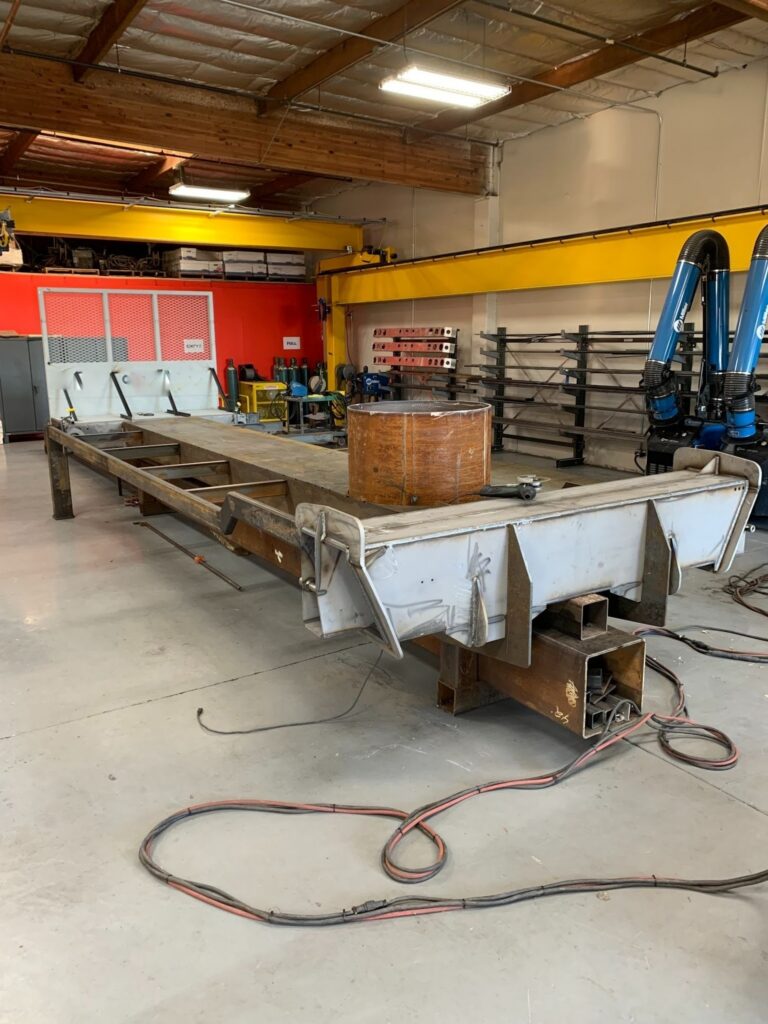
This entry describes a five-day kaizen at a specialty crane manufacturer in the western United States, run on the fabrication of a structural component called the torsion box — a welded-steel chassis assembly that sits inside the crane and carries the bending and torsional loads the crane experiences in the work. The firm builds approximately eighteen cranes a year, on a build clock of about a hundred and twenty days each. Forty of those days are chassis work, of which the torsion box is twenty. Of all the work the kaizen team had been called in to look at, the torsion box turned out to be the wrong place to make faster. The right place to make faster was the relationship between the torsion box and the chassis. The client’s name and the names of individuals have been altered at the client’s request.
The firm makes specialty cranes — low-volume, high-specification, custom-built equipment for industrial and infrastructure customers who need lifting capacity beyond what the standard fleet of mobile cranes provides. Eighteen cranes a year is the firm’s nominal output and the constraint on its annual revenue. Each crane is built on a critical path that runs through chassis work, and the torsion box is the single largest item on that critical path: twenty days of welding, modification, drilling, manual alignment, and flipping a half-tonne assembly between work positions, on a process that has accumulated by trade and by habit rather than by design.
The constraint that mattered most, on the Monday the kaizen began, was not the duration of the torsion-box build but its position on the critical path. The torsion box can only be fabricated once the crane’s chassis has arrived from its outside supplier and its dimensions can be measured — the dog-bone position, the barrel height, the precise axis spacing — because the torsion box has to fit the chassis it will live inside. Chassis deliveries are erratic. The dimensions are often unavailable until the chassis is in front of the firm. The torsion box is therefore both long and late, and its lateness compounds the lateness of every operation downstream of it.
The team’s Tuesday-morning observation was that the torsion box did not need to be made faster. It needed to be made earlier. If the torsion box could be built before the chassis arrived, the twenty days it occupies on the critical path would happen in parallel with the eighty days of work the firm does between order intake and chassis arrival, and the critical path would shorten by twenty days at a stroke. The fabrication-waste problem — the four fabrication steps, the nineteen modifications, the ten drillings, the thirty-three manual alignments, the eight flips, the one hundred and thirty-one process steps in total — was a real problem, but a secondary one. The primary problem was the coupling.
The pivot was to ask which of the chassis-dimension dependencies were actually load-bearing and which were a habit of the legacy design. Two of them turned out to be habits the firm could engineer around. The dog-bone-position dependency could be eliminated by replacing the fixed cleat in the torsion-box mounting interface with an adjustable cleat that could accommodate a small range of dog-bone positions without rework. The barrel-height dependency could be eliminated by widening the acceptable barrel-height range from a single point to a band — a sales-process change rather than an engineering change, but one that required the firm’s sales lead to agree that the acceptable specification range was wider than the firm had been quoting. With both dependencies engineered away, the torsion box could be built any time after the application work for the order was complete.
From Wednesday the team walked the redesign back. Five principal moves came out of the event.
Decouple the torsion box from chassis arrival. The central move. Replace the fixed cleat with an adjustable one; widen the sales specification on barrel height. Most torsion boxes can now be built before the chassis arrives, in parallel with the upstream application work. Twenty days come off the critical path.
Design two replacement boxes — one incremental, one structural. The first new box (Box 1) keeps the existing welded-steel design but adds alignment features and a complete set of pre-cut components. The second (Box 2) replaces welded plates with folded sheet, eliminating most of the welding and several of the flips and possibly reducing weight. Box 1 ships first, on the next crane build; Box 2 follows once finite-element analysis confirms it. The two-track approach gets the firm to faster cycle time immediately and to a structurally cleaner design over the next two quarters.
Eliminate the manual measurements. Of the one hundred and thirty-one process steps in the legacy build, sixty-six are fabrication, modification, drilling, or alignment carried out via tape measure on the bench. The new design removes all of them. The pre-cut component set arrives at the workstation already sized; the alignment features in the redesigned plates self-locate the assembly. Zero tape-measure steps remain.
Replace the jig-and-sawhorse setup with a single height-adjustable jig. The torsion box had been built across a fixed-height welding jig and several sawhorses at differing heights, requiring the operator to adapt the assembly to whichever surface was available. A single height-adjustable jig replaces the lot, with sawhorses retained only for the four flips the new design still requires (down from eight). Working height settles to whatever the operator prefers; the workstation footprint comes down by twenty per cent.
Develop standard work. None had existed. The torsion box had been built from memory, by the small handful of welders who had been doing it for years. Documented standard work — written, posted at the workstation, owned by the fabrication lead — is the precondition for further improvement; without it, the next round of waste-reduction work has nothing to push against.
By the close of Friday the team had drawn a process in which the torsion box no longer waits for the chassis, the new design has been approved for fabrication, the manual measurements have been engineered out, the workstation has been simplified, and the build has a written standard. The state, by closing day:
- Position on the critical path
- 20 days on the critical path → 0 days. Built in parallel with upstream work.
- Process steps
- 131 → ~70.
- Fabrication / modification / drilling / alignment steps
- 66 (4 + 19 + 10 + 33) → 0.
- Flips of the assembly
- 8 → 4 (the folded-sheet design will reduce this further once it ships).
- Build-time variability
- 9 days to 2½ weeks → 5 days.
- Workstation footprint
- Down ~20%.
- Standard work
- None → documented, posted, owned by the fabrication lead.
- Annual crane output capacity
- Constrained at ~18/year by the critical path → headroom for more, contingent on the rest of the chassis work being similarly examined.
The torsion box is the kind of operation that yields obediently to standard kaizen technique. Map the process; identify waste; eliminate it. The team did all of that, and the resulting reductions — sixty-six manual measurement steps to zero, half the flips, half the total step count — are textbook outcomes the discipline routinely produces. But the article that ends here would have missed the load-bearing point.
The load-bearing point is that the torsion box was on the critical path for a reason that had nothing to do with how long it took to build. It was on the critical path because the firm had treated the chassis-dimension dependency as a fact about the world rather than as an engineering decision. Designing waste out of the fabrication process was the visible kaizen activity. Designing the dependency out of the engineering interface was the invisible one, and the invisible one was the one that produced most of the value. A specialty crane manufacturer with a hundred-and-twenty-day build clock can ship cranes faster by reducing the duration of the operations on its critical path; it can also ship cranes faster by removing operations from its critical path. The second is structurally more powerful and is the one the practice has been called in to do most often. It is also the one most clients do not initially recognise as the discipline they have hired.