Pulling a sub-assembly off the critical path
- Lead
- Neil Deshpande and Rishi Malhotra
- Team
- Client-side design lead, fabrication lead, and assembly foreman
- Sector
- Manufacturing — heavy-industrial equipment
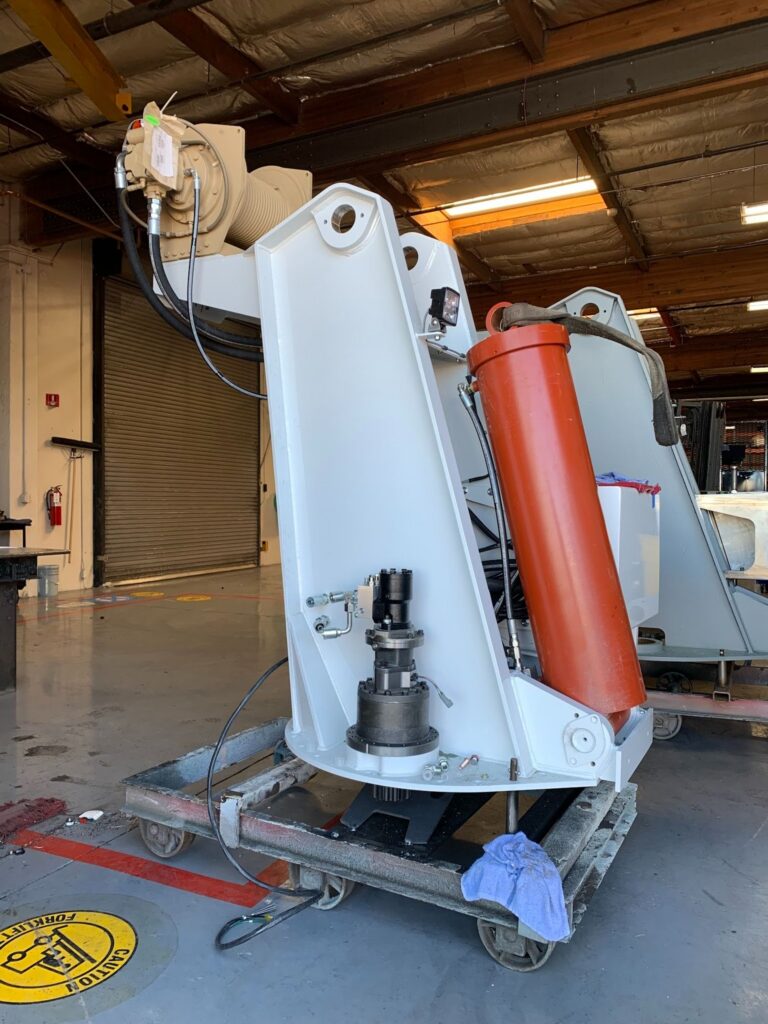
This entry describes a five-day kaizen at a North American heavy-industrial equipment manufacturer, run on the assembly of an upper sub-assembly that carries the hydraulic lines, electrical harnesses, sensors, and actuators driving the unit’s primary moving element. The firm builds approximately twenty units a year on a build clock of about one hundred and twenty days, structured as roughly one hundred days of upstream application and engineering work followed by around three weeks of work on the host structure on the critical path. The sub-assembly’s hydraulic and electrical build was a two-day operation at the back of that critical path. The kaizen brief was to reduce its duration; the kaizen’s structural conclusion was that the larger gain came from removing it from the critical path entirely. The client’s name, the names of individuals, and certain operational specifics have been altered or generalised at the client’s request.
The firm builds heavy-industrial equipment — low-volume, high-specification, custom-built units for industrial customers. Approximately twenty units a year is the firm’s nominal output. Each unit is built on a one-hundred-and-twenty-day clock with about one hundred days of upstream application and engineering work, followed by around three weeks of work on the host structure on the critical path. Of those three weeks, two days are the upper sub-assembly’s hydraulic and electrical build: hoses run, harnesses laid, sensors wired, valves and actuators mounted, the lot lifted into position on the host structure and bolted down. Two days does not sound like much against three weeks, until one notices that the build cannot begin until the host structure is in front of the operator, because the hoses are cut and the harnesses are routed to fit the host they will sit alongside. The two days are at the back of the critical path, and the lateness of the host becomes the lateness of the sub-assembly.
The Tuesday-morning observation was that the two days were not principally an assembly problem. They were a fabrication problem hiding inside an assembly problem. Of approximately ninety process steps the team mapped, more than eighty were waste — and the waste was concentrated in seven categories that the deck spelt out with unusual specificity: around twenty steps of hose-making, a couple of harness-making, four steps of grinding, ten steps of drilling, more than thirty steps of measuring, around eight steps of pulling parts from stores, and a few of positioning the assembly on the bench. The operation had hose-making tools, harness-making tools, grinding wheels, drill presses, tape measures, and a parts crib at one end of the bay; the assembler walked between them carrying half-built sub-assemblies, sized them against the host structure, returned to the bench, and bolted them on. Underneath that pattern sat around seventy-five bolts in over a dozen sizes, scores of blind holes, around a dozen lifts of the assembly between work positions, and several greasing operations. None of it was documented. None of it was standardised. Two adjacent model sizes in the firm’s principal product line used different hose lengths and harness routings, so the assembler was building from memory in two slightly different ways depending on which model the order was for.
The pivot was to ask which of the wasteful steps were inherent to the work and which were artefacts of the firm building things in-house that could be bought made-to-spec. The hose-making and the harness-making — around twenty-two of the eighty-plus steps — were not inherent. The firm was cutting and crimping hoses and routing harnesses to host-specific lengths because the design required host-specific lengths. If the design were standardised across the two model sizes and the lengths quoted to a third-party fabricator, the hoses and harnesses could arrive in the kit, made-to-spec, ready to install. The grinding and the drilling — around fifteen further steps — were the assembler hand-finishing parts that arrived from the firm’s own fabrication shop slightly out of spec; tightening tolerances upstream could eliminate the hand-finishing. The measuring — more than thirty steps — was tape-measure work the assembler did to confirm parts before installation; if the kit was complete and labelled, the measuring went away.
What was left, after the seven waste categories had been engineered out, was an assembly that consisted of laying pre-made hoses and pre-routed harnesses against pre-located mounting points, bolting them down with a reduced bolt-count drawn from a single shadow-board kit, and lifting the completed sub-assembly into position. That assembly fits in one day. More structurally, it fits anywhere in the build clock. With host-specific dimensions engineered out of the hose and harness specifications, the sub-assembly no longer waits for the host. It can be built in parallel with the upstream application work and held ready for the moment the host structure is delivered.
From Wednesday the team walked the redesign back. Six principal moves came out of the event.
Outsource hose and harness fabrication. The roughly twenty-two fabrication steps the firm had been doing on the bench move to a third-party fabricator who supplies pre-made hoses and pre-routed harnesses to the kit. The firm’s own hose-making and harness-making tools come off the bench and out of the bay.
Standardise the design across the two model sizes. The two adjacent model sizes in the firm’s principal product line had been built with different hose lengths and harness routings on a design legacy that did not earn its keep. With the lengths and routings now specified to a third party, both models take the same kit, with model-specific items called out in a small variant section.
Define a kit, on a dedicated cart, complete on day one. Every part the assembly needs comes in a kit on a dedicated cart, drawn against a documented bill of materials. The foreman documents any errors in the kit and the bill of materials is updated. The cart is the single source of parts for the assembly; nothing is pulled from stores during the build.
Reduce the bolt count. Of the roughly seventy-five bolts the legacy assembly used, around a dozen are eliminated by the design changes. The remaining sixty or so are drawn from a smaller set of sizes against the new shadow board.
Document and post the standard work. None had existed. The sub-assembly had been built from memory by the small group of assemblers who had been doing it for years, in two slightly different ways depending on the model. Documented standard work, written and posted at the workstation, owned by the assembly foreman, is the precondition for further improvement; without it, the next round of waste-reduction work has nothing to push against.
Build the workstation. A defined assembly station — a dedicated bay, a shadow board, a parts cart, a whiteboard for visible continuous-improvement tracking — replaces the ad hoc bench setup the assembly had been operating on. The workstation construction is scheduled to complete in about six weeks.
By the close of Friday the team had drawn a process in which the sub-assembly is a one-day kit-and-go operation, runs on standard work, occupies a defined workstation, and — most importantly — runs in parallel with upstream work rather than waiting on host-structure arrival. The state, by closing day:
- Position on the critical path
- 2 days at the back of the critical path → 0 days. Built ahead of host arrival, in parallel with upstream work.
- Total assembly time
- 2 days → 1 day.
- Wasteful steps eliminated
- More than 80 of approximately 90 process steps were in seven waste categories (hose-making, harness-making, grinding, drilling, measuring, pulling parts, positioning); the design and process changes target the elimination of all of them.
- Hose and harness fabrication
- In-house, host-specific → outsourced, standardised across the firm’s two principal model sizes.
- Bolt count
- Around 75 bolts in over a dozen sizes → around 60 bolts in a smaller set of sizes, drawn from a single shadow board.
- Assembly tools at the workstation
- Approximately 35 → fewer than 30, with further reductions to come as the standard work matures.
- Ad hoc work during assembly
- Substantial → zero. Parts kit complete on day one; no fabrication, drilling, grinding, or measuring at the assembly bench.
- Standard work
- None → documented, posted at the workstation, owned by the assembly foreman.
- Workstation
- Ad hoc bench setup → defined assembly bay with shadow board, parts cart, and visible continuous-improvement whiteboard. Construction scheduled to complete in about six weeks.
The structural insight the kaizen surfaced is that the hydraulic and electrical build was on the critical path for reasons that had nothing to do with how long the build itself took. It was on the critical path because the hose lengths and harness routings had been specified to fit the host structure of each unit, and that specification could only be measured once the host was delivered. The kaizen’s central move was to engineer the specification out — to standardise the lengths and routings across the firm’s two model sizes, write them down, and quote them to a fabricator who could deliver against the spec. The visible kaizen activity — eliminating waste at the bench — was the secondary story. The invisible activity — designing the host-structure dependency out of the sub-assembly’s interface — was the one that produced most of the value. A heavy-industrial equipment manufacturer with a four-month build clock can ship units faster by reducing the duration of operations on its critical path. It can also ship units faster by removing operations from its critical path, in sequence, until the path is short enough that the firm’s annual output is no longer constrained by the work on the host structure. That is the discipline the practice has been engaged to apply.